


Pilates vs Weight Lifting for Office Workers: A Simple Guide to Better Core Strength and Posture
- Feb 24
- 7 min read
Introduction
If you sit at a desk all day, your body feels it. Tight hips. A stiff neck. A sore lower back that talks back every time you stand up. Many office workers start searching for answers and land on the same question: pilates vs weight lifting. You are not trying to become a bodybuilder. You just want to feel normal again. Strong. Upright. Pain-free.
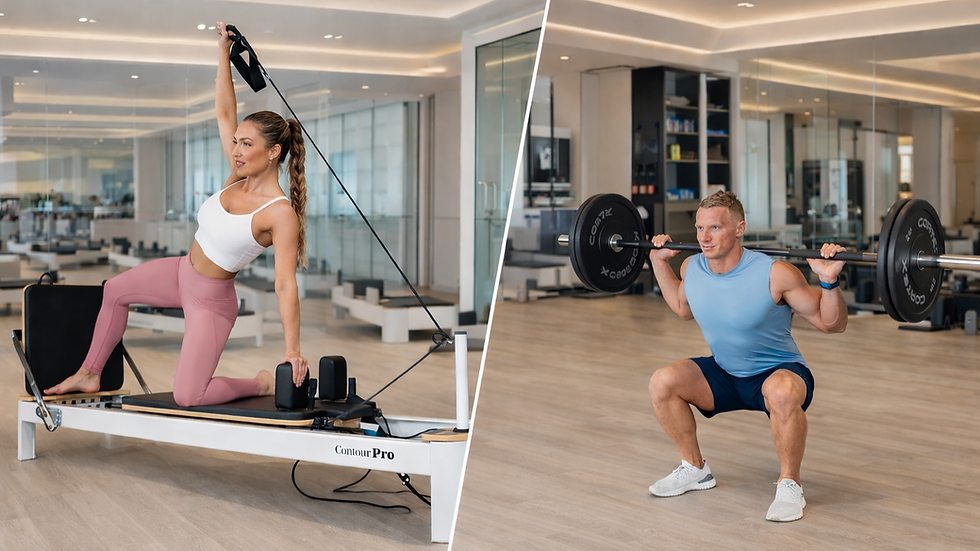
This article is written for people exactly like you.Busy professionals. Office workers. Work-from-home employees.People who are tired, but still want to take care of their bodies.
The Hidden Problems Office Workers Face Every Day
Sitting looks harmless.But hours at a desk quietly change your body.
Your core slowly switches off.Your shoulders roll forward.Your hips tighten.Your lower back starts doing work it was never meant to do.
Over time, this leads to:
Constant back and neck pain
Weak posture muscles
Low energy by mid-afternoon
Trouble focusing
A body that feels older than it should
Most people don’t notice this happening.They just feel worse every year.
That’s why understanding pilates vs weight lifting matters so much for desk workers.
What Is Pilates vs Weight Lifting and Why It Works
Let’s clear this up simply.
Pilates vs weight lifting is not about which one is “better.”It’s about what your body needs right now.
Pilates focuses on slow, controlled movement. You learn how to use your core the right way. You breathe better. You move with control instead of force.
Weight lifting focuses on building muscle by lifting heavier loads. It can be powerful when done correctly. But it often skips posture, breathing, and deep core control.
For office workers, pilates vs weight lifting becomes a question of foundation versus force.
How Pilates vs Weight Lifting Specifically Helps Office Workers
When you look at pilates vs weight lifting, here’s how Pilates supports desk-bound bodies:
Stronger core without strain
Better posture while sitting and standing
Less lower back pain
More energy during the day
Reduced stress through breathing
Improved focus at work
Pilates trains the muscles that support you all day long. Not just the ones you see in the mirror.
This is why many professionals choose pilates vs weight lifting after years of discomfort.
A Realistic Weekly Plan for Busy Professionals
You don’t need to live at the gym.
A simple plan works best:
2–3 sessions per week
45–60 minutes per session
Focus on consistency, not intensity
After 4 weeks, most people notice:
Less back tension
Better posture at their desk
Improved energy levels
Easier movement during daily tasks
When choosing pilates vs weight lifting, consistency always wins.
Pilates vs Gym for Office Workers
Here’s a simple breakdown of pilates vs weight lifting for desk workers:
Gym / Weight Lifting
Heavy loads
Fast movements
Easy to use poor form
Can increase tightness
Pilates
Controlled movements
Posture-focused
Safer for beginners
Builds balanced strength
This comparison helps office workers understand pilates vs weight lifting without confusion.
Popular Pelvic Pilates Exercises
Pelvic strength matters more than most people realize. Here are common pelvic Pilates exercises explained simply:
Pelvic tilts help wake up your deep core and ease lower back tension. Bridge pose strengthens glutes and supports the spine. Kegel activation improves pelvic control and stability. Dead bug teaches core control while protecting the back. Clamshell strengthens hips, which reduces pressure on the spine.
These exercises support long-term posture and comfort for desk workers.
Two Real-Life Office Worker Scenarios
Scenario One:Mark works in IT. He sits 9 hours a day. His lower back hurts every morning. After choosing Pilates over heavy lifting, his posture improved and his pain slowly faded.
Scenario Two:Sarah manages a corporate team. Stress and long meetings ruined her energy. Pilates helped her breathe better, sit taller, and feel calmer at work.
Stories like these are why people explore pilates vs weight lifting seriously.
Why Blue Chip Conditioning Is Different
At Blue Chip Conditioning, the focus is simple.
Small class sizes
Trainers who watch your form
Calm, clean space
Beginner-friendly sessions
Real posture correction
This approach supports Flexibility and strength training in a way that feels safe and personal.
Posture, Strength, and Long-Term Health
Office workers don’t need more pressure. They need smarter movement.
Pilates builds Postural strength training from the inside out. It supports joints, spine, and breathing.
This is why Flexibility and strength training works best when posture comes first.
Pilates in Las Vegas for Office Workers
Finding quality pilates in las vegas matters.Not all studios focus on posture and core control.
Professionals searching for pilates vegas often want guidance, not intensity.A proper pilates class las vegas should leave you feeling supported, not exhausted.
Some professionals also explore studio rental las vegas options for private sessions.
Pilates vs Weight Lifting and Injury Prevention
Many desk workers already move poorly.Adding heavy loads can increase risk.
This is where pilates vs weight lifting becomes important for safety.
Pilates teaches control first.Strength follows naturally.
This style of Postural strength training protects your body long-term.
Common Myths Office Workers Believe
“Pilates is too easy.”It’s controlled, not easy.
“I’m not flexible.”Pilates improves flexibility safely.
“It’s only for women.”Pilates was created for rehabilitation.
“Gym is always better.”It depends on your body’s needs.
Understanding these myths helps clarify pilates vs weight lifting choices.
Flexibility and Strength Training That Fits Real Life
Office workers need movement that fits their schedule.They need Flexibility and strength training that supports daily life.
Pilates offers structure without overload. That’s why Postural strength training remains essential for desk workers.
Pilates Vegas and the Office Lifestyle
Professionals searching for pilates vegas often feel overwhelmed by choices.A good pilates class las vegas focuses on posture, breathing, and control.
Some even look into studio rental las vegas for quieter sessions.
Quality pilates in las vegas should feel welcoming and calm.
Why Pilates vs Weight Lifting Keeps Showing Up
People don’t ask about pilates vs weight lifting out of curiosity. They ask because something hurts.
Pain is information. Pilates listens to it.
That’s why pilates vs weight lifting remains a key conversation for office workers.
FAQ
1. Is Pilates better than weight lifting for office workers with back pain?
For many office workers, yes. Pilates focuses on posture, core control, and gentle strength, which directly supports the spine. Weight lifting can help too, but without proper form, it may increase back strain. That’s why many desk workers feel safer starting with Pilates.
2. Can Pilates really improve posture from sitting all day?
Yes, and this is one of its biggest strengths. Pilates trains the deep muscles that keep you upright while sitting and standing. Over time, you naturally stop slouching because your body learns better alignment instead of forcing it.
3. How long does it take to see results from Pilates for desk job pain?
Most people notice small changes in 2–3 weeks, like less stiffness and better awareness. Around 4–6 weeks, posture improves and daily aches often reduce. Consistency matters more than intensity.
4. Is Pilates safe for beginners who have never exercised before?
Very safe when taught correctly. Pilates movements are controlled and low impact. Beginners can start slowly and build strength without feeling overwhelmed or sore in unhealthy ways.
5. Do I need to be flexible to start Pilates?
No. This is a common myth. Pilates actually helps you become more flexible over time. You start where your body is today, not where you think it should be.
6. Can Pilates replace weight lifting for strength training?
For many office workers, Pilates provides enough strength training, especially for the core, hips, and posture muscles. Some people later add weight lifting once their movement improves. Pilates builds the foundation first.
7. How often should busy professionals do Pilates each week?
Two to three sessions per week is ideal. Even twice a week can make a big difference if done consistently. More sessions don’t help if your body doesn’t recover.
8. Will Pilates help with neck and shoulder pain from computer work?
Yes. Pilates improves shoulder stability, neck alignment, and breathing. This reduces tension caused by screens, phones, and long meetings. Many office workers feel relief within the first month.
9. Is Pilates good for athletes recovering from desk-related injuries?
Yes. Pilates is often used in rehabilitation because it restores movement quality. Athletes with desk jobs benefit from improved control, balance, and reduced compensation patterns.
10. What should I expect in my first Pilates session as an office worker?
You’ll move slowly, focus on breathing, and learn how to engage your core properly. You may feel muscles you’ve never noticed before. Most people leave feeling lighter, taller, and calmer not exhausted.
Conclusion: Choosing What Truly Supports Your Body
If you sit most of the day, your body is quietly asking for help. Not more pressure. Not harder workouts. Just better support.
When people search for pilates vs weight lifting, they’re usually not chasing big muscles. They’re looking for relief. Better posture. Less pain at the end of a long workday. More energy to enjoy life outside the office.
Pilates meets those needs in a simple, thoughtful way. It teaches your body how to move correctly again. It strengthens your core without stressing your joints. It helps you sit taller, breathe better, and feel more in control of your body.
Weight lifting can be useful, but without a strong foundation, it often adds strain instead of solving the real problem. For many office workers, Pilates becomes the missing piece the reset their body has needed for years.
The most important thing to remember is this: Your body adapts to what you do every day. Hours of sitting don’t disappear on their own. But with the right kind of movement, you can undo the damage slowly and safely.
You don’t need perfection. You don’t need extreme workouts. You just need consistency and the right guidance.
If you’re ready to feel better in your body not just stronger, but more comfortable and confident trying a Pilates session is a meaningful first step. Your body has been carrying you through long days and busy schedules. Now might be the right time to return the favor.
Your Next Step, at Your Own Pace
Your body shows up for you every day through long meetings, tight deadlines, and constant mental pressure. It holds more than you realize. Giving it proper support isn’t a luxury, it’s part of staying well.
If you’re curious about posture-focused movement and want to experience it for yourself, you’re welcome to try a session at Blue Chip Conditioning. There’s no rush and no pressure just a chance to move better, feel lighter, and reconnect with your body.
Sometimes, one small, thoughtful step is all it takes to feel real relief.


Comments